Enigma Mushrooms
Buy Enigma Mushrooms
Enigma Mushrooms: The World's Most Potent Psilocybe Cubensis Strain Explained (2026 Guide)
Last Updated: April 2026 | Reading Time: ~9 minutes
If you've spent any time exploring the world of psychedelic fungi, you've probably heard the name Enigma spoken with a kind of hushed reverence. And for good reason. Enigma mushrooms aren't just another strain on a long list of Psilocybe cubensis varieties they're something else entirely. A genetic anomaly. A biological curveball that challenges everything we think we know about how mushrooms grow, reproduce, and affect the human mind.
In this comprehensive 2026 guide, we're breaking down everything you need to know about Enigma mushrooms from their disputed origins and bizarre morphology to their record-breaking potency, cultivation challenges, therapeutic potential, and legal status. Whether you're a seasoned mycology enthusiast or simply curious about what's generating so much buzz in the psychedelic community, this is your definitive resource.
What Are Enigma Mushrooms?
At its core, the Enigma mushroom is a **sterile, non-sporulating mutation of *Psilocybe cubensis*** the world's most commonly cultivated psychedelic mushroom species. But calling it simply a "mutation" undersells just how strange and remarkable this organism truly is.
Unlike every other cubensis variety you've ever seen with their familiar caps, stems, and gills Enigma skips all of that. Instead of following the standard developmental arc from mycelium to pinhead to classic capped fruiting body, Enigma's primordia enter a state of continuous, undifferentiated growth. The cells keep dividing without ever forming the specialized reproductive structures found in typical mushrooms: no gills, no basidia, no spores.
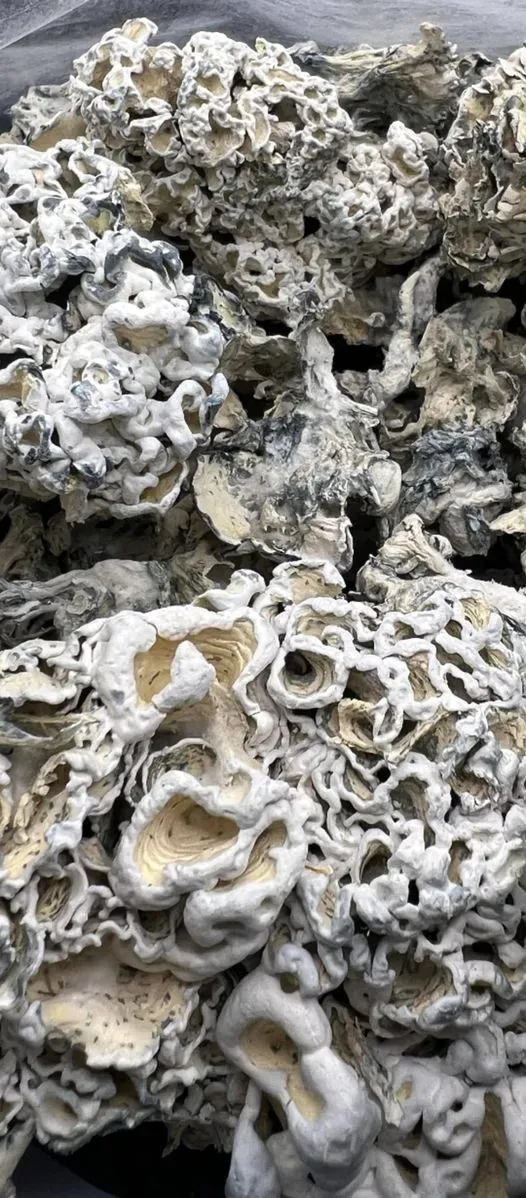
What you're left with is a dense, folded mass of tissue that can reach the size of a baseball or larger. Community members have compared it to brain coral, cauliflower heads, or cosmic sea creatures. The nicknames "blob mutation," "fin mutation," "Brainiac" all try to capture something that doesn't quite fit into any familiar category.
Also known as Tidal Wave 2 and OMNI, Enigma is, in the words of one mycology publication, "not a strain in the classic sense, but a stable mutation of cubensis a genetic anomaly preserved by the community."
The Origins of Enigma: A Story of Controversy and Community
The history of Enigma mushrooms is as strange as the mushroom itself. It didn't emerge from some laboratory or ancient rainforest. It began as a spontaneous mutation that appeared during a cultivation run and then it sparked a genuine controversy within the mycology world that still hasn't entirely settled.
Enigma is widely understood to have originated from Tidal Wave genetics, which itself is a hybrid of two legendary high-potency strains: Penis Envy and B+. At some point during cultivation with Tidal Wave-related genetics, a grower depending on which account you believe, either Boomer Smith or Magic Myco noticed that one of their grows had produced something unusual. Rather than normal mushrooms, the substrate was slowly being consumed by an expanding mass of undifferentiated fungal tissue.
Magic Myco named his version of this mutation "Tidal Wave 2," under which name it went on to win the Oakland Hyphae Psilocybin Cup. Boomer Smith's version became known as "Enigma." The debates around ownership, naming conventions, and whether such a unique genetic discovery should be freely shared with the community or monetized became a defining conversation in mycology circles around 2021–2022.
What's undisputed is the outcome: both names refer to the same remarkable phenomenon, and the strain itself with its biological uniqueness and extraordinary potency has become one of the most sought-after genetics in the entire cubensis world.
Enigma's Appearance: What Does It Look Like?
This is where things get visually fascinating. When you see an Enigma culture for the first time, it takes a moment to process what you're looking at.
There are no caps. No stems. No gills. Just a deeply furrowed, irregular mass of compressed fungal tissue white to off-white in its earlier stages, shifting toward a creamy or golden tone as it matures. The surface is densely textured, with folded ridges that call to mind brain coral, a head of cauliflower, or (as many growers put it) something you might find in the deep ocean rather than a grow tent.
Another notable visual characteristic: intense blue bruising. When Enigma tissue is handled, cut, or damaged, it rapidly oxidizes and turns a vivid blue color. This bruising is caused by the conversion of psilocin a key psychoactive compound and it's both a visual indicator of the mushroom's chemical richness and a hallmark that distinguishes it from look-alikes.
Because Enigma produces no spores, it cannot be identified by spore print the way conventional mushrooms are. Instead, cultivators rely on hyphal morphology under microscopy septate hyphae with visible clamp connections, consistent with Psilocybe cubensis along with the unmistakable tissue structure to confirm identification.
How Potent Is the Enigma Mushroom?
Here's where the legend of Enigma is most justified and most scientifically documented.
In the 2022 Oakland Hyphae Psilocybin Cup, Enigma-type mutations claimed both first and second place in the potency category, posting total tryptamine content of 2.26% psilocybin, 1.56% psilocin, and a combined alkaloid content of 3.82% in the top-ranked sample. For context, the average Psilocybe cubensis mushroom contains between 0.6–0.8% total tryptamines. That puts Enigma at roughly four times the potency of a standard cubensis variety.
Compare this to other high-potency benchmarks within the species:
- Golden Teacher (beginner-friendly baseline): 0.6–0.8% tryptamines
- Penis Envy (widely considered the next tier): 1.2–1.8% tryptamines
- Tidal Wave (Enigma's parent, 2021 Cup winner): above-average cubensis
- Enigma: consistently 2.0–3.8%+ tryptamines
One leading hypothesis for why Enigma is so potent relates to its sterility. In a typical mushroom, a significant portion of metabolic energy is directed toward reproduction building gills, producing spores, and completing the biological imperative of propagation. Enigma can't do any of that. With that biological demand removed, it may redirect metabolic resources toward producing alkaloids the very compounds that make the psychedelic experience possible.
This is still a hypothesis rather than a confirmed mechanism, and as researchers at Miraculix Lab note, formal potency comparisons for Enigma remain scarce relative to conventional strains, due to its rarity and cultivation difficulty. But the contest data is hard to argue with.
The Enigma Experience: Effects, Onset, and Duration
Because of its exceptional potency, the effects of Enigma are categorically different not just stronger than what most users experience with typical cubensis strains.
Onset and Duration
Effects typically begin within 30–60 minutes of consumption, with peak intensity arriving between 2–4 hours. The complete experience can run 6–8 hours or longer, depending on dosage and individual factors.
What to Expect
Users across community forums and cultivation circles consistently describe Enigma experiences as:
- Vivid, complex visual hallucinations geometric patterns, fractals, and environmental distortions that are significantly more pronounced than other cubensis strains
- Deep emotional introspection a tendency toward self-examination, pattern recognition in one's own life, and psychological processing
- Ego dissolution at higher doses a dissolution of the usual boundaries between self and environment, often described as one of the most profound psychological experiences possible
- Mystical or transcendent states at mega-doses (4g+), some users describe experiences qualitatively similar to DMT or ayahuasca, with feelings of unity, connectedness, and what psychedelic researchers term "mystical-type experiences"
A Word on Set and Setting
Given the intensity of the Enigma experience, the concept of set and setting your mindset going in and the physical/social environment you're in is arguably more critical here than with any other cubensis variety. This is not a casual or spontaneous strain. Experienced psychonauts approach Enigma with intention, preparation, and ideally a trusted companion or guide.
Dosage: Start Far Lower Than You Think
Dosing Enigma is one area where conventional wisdom about cubensis mushrooms actively misleads you and can lead to profoundly overwhelming experiences for the unprepared.
Where a typical recreational cubensis dose might fall in the 2–3.5 gram range, Enigma demands a dramatically more cautious approach:
| Experience Level | Suggested Enigma Dose |
|---|---|
| Microdose (sub-perceptual) | 0.05g – 0.15g |
| Low / Introductory | 0.25g – 0.5g |
| Moderate | 0.5g – 1.5g |
| Strong | 1.5g – 2.5g |
| Heavy / Veterans only | 2.5g+ |
This is not a strain for beginners. Its potency means that even experienced users should titrate carefully, especially early in their experience with this particular variety.
Cultivation: Why Enigma Is So Rare and Difficult to Grow
The scarcity of Enigma isn't just about demand. It's fundamentally baked into the mushroom's biology.
No Spores, No Traditional Propagation
Most mushroom cultivation begins with a spore syringe or spore print collecting the microscopic reproductive units that a mushroom drops from its cap. Enigma doesn't have a cap. It has never produced viable spores. Every sample of Enigma in existence is genetically identical to the original mutation because the only way to propagate it is through tissue cloning collecting living mycelium tissue and transferring it under sterile conditions to new substrate.
This requires:
- A sterile laboratory-level environment (flow hood or still air box)
- Agar plates or liquid culture for tissue transfer
- Sterile scalpels, petri dishes, and technical skill
- Knowledge of contamination identification and prevention
For most home cultivators, this represents a significant technical barrier. Unlike growing from spores which is relatively accessible tissue culture work belongs to an intermediate-to-advanced skill tier.
Slow Growth Cycle
Where standard cubensis strains might produce harvestable fruits within 2–3 weeks under optimal conditions, Enigma formations typically take 6–8 weeks or longer to develop fully. Patience isn't optional it's a prerequisite.
Harvesting Enigma Correctly
Harvesting is also non-standard. You can't use the "veil breaking" rule that applies to capped mushrooms. Instead, the key indicators of harvest readiness are:
- A color shift from bright white to slightly off-white, creamy, or golden
- A surface texture that becomes firmer and slightly more rigid
- A slowdown in visible growth
Rather than twisting or tearing (which can damage the base and disrupt the substrate), experienced cultivators recommend using a sharp scalpel or fine blade for controlled, clean cuts.
Enigma and the Science of Psilocybin Therapy
Whatever your personal relationship with psychedelics, it's impossible to write about high-potency psilocybin mushrooms in 2026 without acknowledging the remarkable science happening in this field.
The Johns Hopkins Center for Psychedelic and Consciousness Research the world's largest psychedelic research center has produced over 150 peer-reviewed publications exploring psilocybin's therapeutic potential since 2000. Research programs there and at institutions including NYU, UC Berkeley, and Imperial College London have examined psilocybin's effects on:
- Major depressive disorder with studies showing substantial antidepressant effects lasting up to a year after treatment
- Treatment-resistant depression
- End-of-life anxiety in cancer patients
- Tobacco and alcohol addiction
- PTSD and OCD
A landmark study published in JAMA Psychiatry found that psilocybin-assisted therapy produced large decreases in depression severity that persisted through one-year follow-up assessments. Separately, a 2023 prospective survey of naturalistic psilocybin use involving over 2,800 participants, published and supported by Johns Hopkins researchers, found lasting reductions in anxiety, depression, and alcohol misuse alongside increases in cognitive flexibility and emotional regulation.
It's worth being clear: Enigma mushrooms, as an extremely high-potency variant, are very much not the context for therapeutic research, which uses standardized, measured doses in controlled clinical settings. But understanding the serious science behind psilocybin illuminates why this entire area of mycology has captured the attention it has.
Enigma vs. Other Popular Strains: A Direct Comparison
| Strain | Tryptamine % | Morphology | Difficulty | Best For |
|---|---|---|---|---|
| Golden Teacher | 0.6–0.8% | Classic cap/stem | Beginner | First-timers |
| B+ | 0.7–1.0% | Large, golden caps | Beginner | Versatile grow |
| Penis Envy | 1.2–1.8% | Dense, knobby caps | Intermediate | High-potency seekers |
| Tidal Wave | ~1.5–2.0% | Classic form, high yield | Intermediate | Parent strain |
| Enigma | 2.0–3.82% | Coral/brain blob | Advanced | Experienced cultivators |
Legal Status: Know Before You Go
Psilocybin and psilocin the active compounds in Enigma remain Schedule I controlled substances under United States federal law, as well as in most countries worldwide. Possession, cultivation, and distribution carry serious legal penalties at the federal level in the U.S.
That said, the legal landscape is evolving:
- Oregon has implemented regulated psilocybin therapy services under Measure 109
- Colorado legalized personal psilocybin use for adults under Proposition 122
- Several cities including Denver, Seattle, and Ann Arbor have deprioritized enforcement
If you're in a jurisdiction where psilocybin is not decriminalized or legal, Enigma spores (in jurisdictions that permit spore possession for microscopy research) exist in a different legal space than cultivated mushrooms though this varies significantly by location.
Always research the laws applicable to your specific jurisdiction before engaging with any psilocybin-related material. Resources like MAPS (Multidisciplinary Association for Psychedelic Studies) and DanceSafe provide harm reduction and legal information for those navigating this landscape.
Common Myths About Enigma Mushrooms Debunked
Myth: Enigma is a separate mushroom species. Fact: It's a mutation of Psilocybe cubensis the same species, radically different expression.
Myth: Enigma can be grown from spores. Fact: Enigma is completely sterile. It has never produced spores and can only be propagated through tissue cloning.
Myth: Enigma is dangerous because it looks different. Fact: The unusual morphology is a cosmetic mutation, not a sign of toxicity. The risks associated with Enigma relate to its extreme potency, not its appearance.
Myth: More potent automatically means better. Fact: Potency without experience, preparation, and intentionality is a recipe for difficult experiences. The "best" mushroom is always the one matched to the user's experience level and intent.
Final Thoughts: Why Enigma Matters
Enigma mushrooms represent something genuinely rare in the natural world: a stable, preserved mutation that challenges the boundaries of what a fungus can be. It grows without producing spores. It builds tissue instead of fruiting bodies. It concentrates psychoactive compounds at levels that break records. And it continues to be propagated clone by clone, generation by generation by a global community of cultivators who recognized from the start that they were dealing with something unprecedented.
As scientific research into psilocybin continues to mature, and as legal frameworks around psychedelics continue to evolve, Enigma sits at an interesting intersection: a biological anomaly that happens to carry compounds at the cutting edge of mental health research.
Whether you approach it from a cultivation standpoint, a scientific lens, or a personal journey into psychedelic experience, Enigma rewards careful attention. It is, in every sense of the word, enigmatic and understanding it a little better is a worthwhile endeavor.
This article is intended for educational and informational purposes only. The cultivation, possession, and use of psilocybin mushrooms is illegal in many jurisdictions. Always research and comply with the laws applicable in your area. This content does not constitute medical or legal advice.
Further Reading & Authoritative Resources: